
Published: 11/08/2026
Modified: 28/09/2026
KLA Flags on the Fence of Serbian Orthodox Churches in Lipljan Confirm the Deterioration of the Security Situation in Kosovo and Metohija
Statement of the Diocese of Raška and Prizren
Gračanica, 10 August 2026
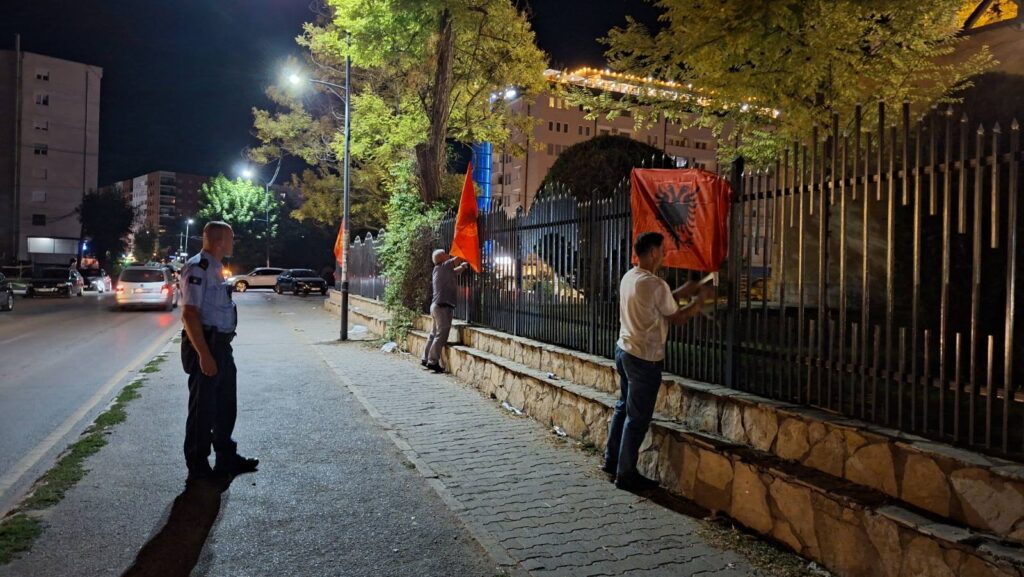
The Diocese of Raška and Prizren condemns in the strongest terms the act of desecration and overt nationalist provocation that took place last night in Lipljan, where two ethnic Albanian individuals placed the flags of the KLA and the Republic of Albania on the fence of the churchyard containing the medieval fourteenth-century Church of the Entry of the Most Holy Theotokos into the Temple and the Church of the Holy Martyrs Florus and Laurus.
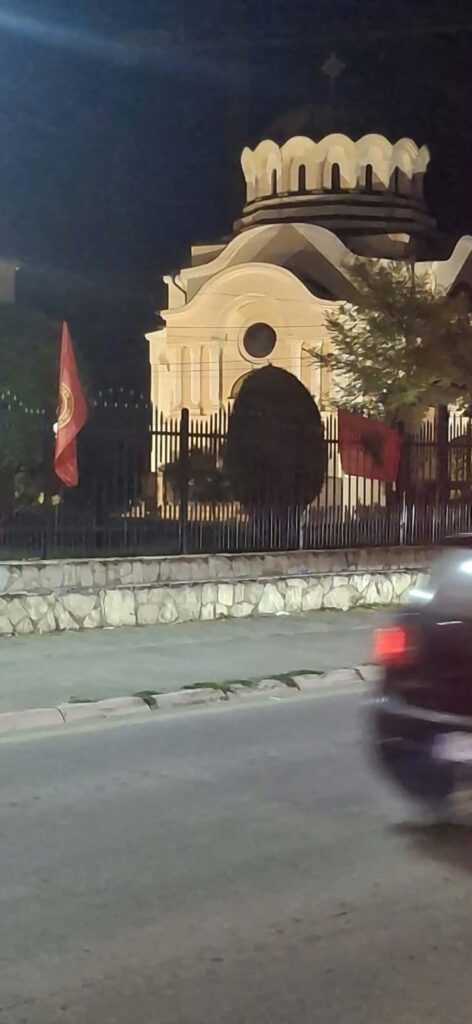 According to the information available to us, on the evening of 10 August 2026, officers of the Kosovo Police, while patrolling this part of central Lipljan, encountered the two perpetrators as they were placing the flags, detained them and subsequently removed the flags from the church fence. Notwithstanding the police response, the true attitude of the institutions towards this act will be demonstrated by the subsequent proceedings, its legal classification and the willingness of the prosecution and the court to establish the motives and responsibility of the perpetrators.
This incident must not be reduced to an ordinary public order offence, improper conduct or an insignificant act of vandalism. The Diocese possesses CCTV footage and, as soon as the Kosovo Police officially provides it with information regarding the identities of the detained individuals, it will file a criminal complaint against both of them with the competent Prosecutor’s Office. We shall request an objective investigation into whether this act contains elements of incitement to ethnic and religious hatred, intimidation of the remaining Orthodox Serbs and the deliberate desecration of a protected medieval religious and cultural heritage site.
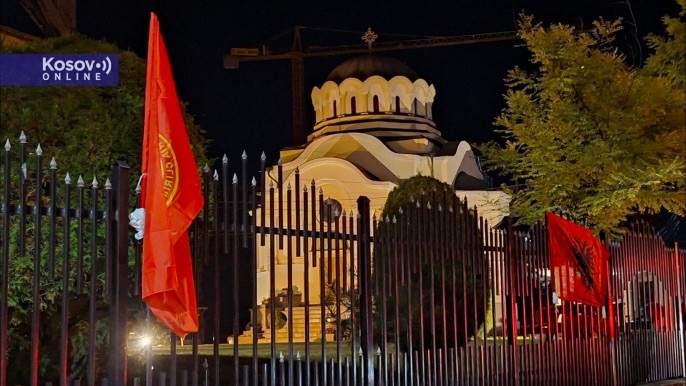 The placement of a KLA flag on the fence of a Serbian Orthodox church is not the neutral display of a political symbol. In the lived experience of the Serbian people in Kosovo and Metohija, and particularly of the remaining Serbs in Lipljan, KLA insignia are inseparably associated with armed violence, abductions, killings, persecution, the destruction of homes and the desecration of Orthodox holy sites, for which those responsible have never been brought to justice. Placing such a flag on the fence of a fourteenth-century church constitutes a deliberate act of intimidation and a symbolic assertion of control over property belonging to the Serbian Orthodox Church.
The simultaneous placement of the flag of the Republic of Albania and the KLA flag on a Serbian holy site cannot be interpreted as accidental or thoughtless. It represents an attempt to mark an ancient Serbian Orthodox space with the emblems of Albanian nationalism and of an armed formation under whose symbols Serbs from this area suffered and were expelled, while 150 Serbian churches have been destroyed or brutally desecrated since 1999.
 The position of the small number of remaining Serbs in Lipljan gives this act particular gravity. Only a few hundred Serbs now live in the town, compared with several thousand in the past. These two churches constitute their spiritual centre and one of the last visible testimonies to the centuries-old Serbian Orthodox presence there. An attack on the churchyard is therefore not merely an attack on a fence or on property, but a message to the remaining Serbs that they are not safe even in their own holy places, and that the very sign of their continued existence may be subjected to contempt.
Last night’s incident is not an isolated one. In December 2025, a masked individual forcibly removed from the same church complex the flag of the Serbian Orthodox Church, which had been displayed for the patronal feast. A similar incident occurred in June 2023. The failure to identify and appropriately punish the perpetrators in the earlier cases deepened the sense of impunity and opened the way for further provocations.
This incident must also be viewed in the context of other events that have seriously disturbed the Serbian Orthodox Church and the Serbian people in recent weeks. Following the peaceful conclusion of the memorial service at Gazimestan, 37 Serbs, including a minor, were detained, while several of those detained made serious allegations of physical and psychological abuse, ethnic insults and humiliation by police officers. During the patronal feast of the Monastery of the Holy Archangels near Prizren, worshippers, including women, children, elderly people and clergy, were subjected to treatment by the Kosovo Police that they experienced as humiliating and intimidating.
At the same time, pilgrimage groups have been placed in legal uncertainty by the announced application of regulations intended for commercial tourism, opening the possibility of administrative restrictions on the arrival of the faithful at holy sites, although such access lies at the very heart of freedom of religion. Within the Special Protective Zone of Visoki Dečani Monastery, extensive works were once again carried out along the route of the transit road, which is prohibited by law, without any response from the authorities responsible for enforcing that law.
Although the police patrol responded last night, the broader pattern of selective enforcement remains a cause of profound concern. When Serbs peacefully display their national symbols, sing their songs or come to their holy sites, their conduct is frequently treated as a security problem. By contrast, incidents involving the display of KLA flags for the purpose of intimidating Serbs, attacks on Church property and other ethnically and religiously motivated provocations almost invariably remain without appropriate legal classification or judicial outcome. It is precisely this inequality that has reduced the Serbian people’s confidence in the Kosovo Police to its lowest level in the past twenty years.
It is particularly alarming that last night’s incident occurred only a few hours after KFOR, referring to the “improved security situation in Kosovo”, announced that it was beginning the gradual integration of Kosovo Police personnel into its security system around Visoki Dečani Monastery, as part of a broader “optimisation process” concerning its presence. On the same day, a change was also announced to KFOR’s existing engagement at the main bridge over the Ibar River in Kosovo Mitrovica, causing additional concern among the Serbian residents of the city.
Precisely because the Diocese highly values KFOR’s role to date in protecting our holy sites and our people, we are duty-bound to state clearly that the assessment of an improved security situation does not accurately reflect the reality in which Serbs and the Serbian Orthodox Church live. The events of recent weeks demonstrate that a security assessment based primarily on the absence of major armed incidents remains incomplete.
A community is not secure if its members live in fear of police searches, detention, entry bans, administrative restrictions, the desecration of holy sites and the public display of symbols associated in their experience with persecution and suffering. The absence of mass violence is not proof of normalisation if daily pressure discourages people from coming to their churches, drives them towards emigration and gradually removes them from public life. At the same time, public confidence in the police must be founded upon the impartial enforcement of the law.
The Diocese notes KFOR’s assurance that it will retain its role as the first responder directly responsible for the security of Visoki Dečani Monastery. However, the present circumstances provide no objective basis for reducing direct international protection or for transferring primary and direct responsibility for the security of Visoki Dečani to the Kosovo Police.
Any additional involvement of the Kosovo Police around the Monastery can be based only upon a visible improvement in the conduct of Kosovo institutions towards the Monastery and respect for the agreed decision of the Implementation and Monitoring Council, IMC, of November 2020 concerning the construction of a bypass road. Any such involvement must also be reversible should conditions deteriorate and must be implemented in full coordination with KFOR, the Diocese and the Monastery. KFOR’s retention of direct responsibility does not constitute a request for privilege on the part of the Church, but a necessary preventive measure at a site of exceptional religious, cultural and security sensitivity.
The Diocese is also deeply concerned by the absence of sufficiently clear and timely reactions from international representatives to the recent deterioration in the position of Serbs and the Serbian Orthodox Church. In an atmosphere in which attacks frequently remain without an effective judicial outcome, while the public glorification of the KLA and insults directed against Serbs pass without adequate condemnation, restrained or delayed reactions create a sense of impunity and risk encouraging further provocations.
Numerous insulting, threatening and dehumanising messages in certain media outlets and on social media, the increasingly open denial of the Serbian identity of Orthodox holy sites and the public justification of attacks further worsen the atmosphere and create a climate in which collective guilt is attributed to all Serbs, thereby encouraging new provocations and acts of violence. Amid a continuing political and institutional crisis, the authorities in Pristina bear a particular responsibility to prevent anti-Serbian rhetoric and selective institutional conduct from being used as instruments of political mobilisation and populism.
The Diocese of Raška and Prizren will request that the competent Prosecutor’s Office urgently take up this case, examine the motives of the perpetrators and legally classify the act in accordance with its true gravity. We call upon the Kosovo Police to provide official information concerning the detained individuals without delay and to ensure the preservation of all evidence. From KFOR, EULEX, the OSCE, the European Union and diplomatic missions, we expect a clear public condemnation, careful monitoring of the subsequent proceedings and concrete action to prevent similar incidents.
We call upon our faithful people, and particularly the remaining Serbs in Lipljan and the surrounding area, to remain peaceful, composed, dignified and resolute. We must not succumb to the provocations of extremists, nor allow anyone’s threats to provoke us into an ill-considered act that could be used against our people.
We shall defend our homes, holy sites and graves through peaceful and steadfast presence, lawful means, bearing witness to the truth and unwavering faith in Christ. We shall not answer hatred with hatred, but neither shall we remain silent in the face of injustice. Christian forbearance is not acceptance of humiliation, and peacemaking does not mean that those under threat must renounce the truth or their right to survive.
The Serbian Orthodox Church stands with its people in Kosovo and Metohija. Our holy sites are not abandoned monuments upon which our centuries-old history and identity may be denied. They are living houses of God and places in which our people have prayed for centuries. We shall remain with them, bear witness to the truth and demand accountability, knowing that genuine peace is not built by concealing danger, but by recognising it and resolutely opposing every form of hatred, discrimination and violence.
